UTM Tracking
Call Tracking
Ad Spend
Lead Sources
How to Track Marketing Attribution for a Small Business
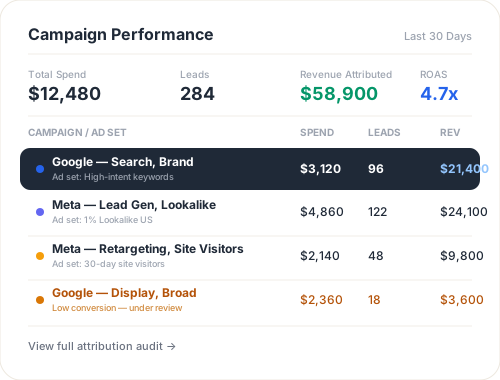
Most small businesses are guessing which marketing is actually working, and paying for the guess every month.
If you're running Google Ads, doing some social, and getting a mix of referrals and organic traffic, chances are you can tell me how much you're spending. Very few businesses can tell me, with confidence, which of those channels is actually producing paying customers.
That gap between what you're spending and what you can actually prove is working… is marketing attribution. Without it, budget decisions come down to whoever's loudest in the room, not what the data says.
Most small businesses either don't track it at all, or track it partially. Usually a Google Ads dashboard here, a "how'd you hear about us" field there. Which none of it connected, none of it telling the same story.
What proper marketing attribution actually looks like
Real attribution means every lead, no matter how it came in like a form fill, a phone call, a DM, a referral, etc. is tagged back to its actual source, and that source is connected all the way through to whether it became a paying customer.
That means UTM parameters on every ad and link, call tracking numbers so phone leads aren't a black hole, and a CRM field that captures source at the moment a lead comes in rather than trying to reconstruct it later. Done right, you can look at any dollar you spent and trace it to the revenue it produced.
"We were spending on Google Ads, Meta, and referrals and had no idea which one was actually working. Now I know exactly where every job came from, down to the campaign."
How marketing attribution tracking works, step by step
Step 1: We map every channel you're currently using to generate leads such as ads, organic, referrals, social, walk-ins. Then identify where attribution is currently missing or broken.
Step 2: We implement UTM tracking on every paid and organic link, set up call tracking numbers for phone leads, and connect lead source fields directly into your CRM so nothing has to be manually reconstructed later.
Step 3: We build reporting that ties spend on each channel directly to closed revenue, so you can see real return, not just clicks and impressions.
Real example
A service business running Google Ads and Meta Ads had no way to tell which platform was actually producing jobs. Leads were coming in through both, plus referrals, with no consistent tracking connecting any of it to revenue.
After implementing UTM tracking and call tracking across every channel, the business could see for the first time which campaigns were producing real, closed jobs versus which were just generating clicks. Budget shifted toward what was actually converting, and marketing spend stopped being a guess.
What's included
Everything needed to go from guessing to knowing exactly what's working:
01
02
03
04
05
Your questions, answered
Straightforward answers about how this works, so you know what to expect before we talk.
Do I need to already be running ads to do this?
No. This works whether you're actively running paid ads or relying mostly on organic and referrals — the goal is knowing where every lead actually comes from, regardless of channel.
What if most of our leads come in by phone, not online?
That's exactly what call tracking solves. Phone leads are often the most under-tracked source in a small business, and they're just as attributable as a form fill once tracking numbers are in place.
Will this slow down my sales team?
No — tracking is built to capture source automatically at the point a lead comes in, not as an extra step your team has to remember to do.
How long does this take to set up?
Most setups are live within a week, similar to the CRM pipeline work — the bulk of the time is mapping your actual channels before anything gets implemented.
